
TRU Group Graphite-Graphene & Carbon
High-tech Graphite-Graphene & Specialty Carbon Process Engineering
Graphite-Graphene use: battery + fuel cell + electrodes + nuclear + lubricant + fire retardant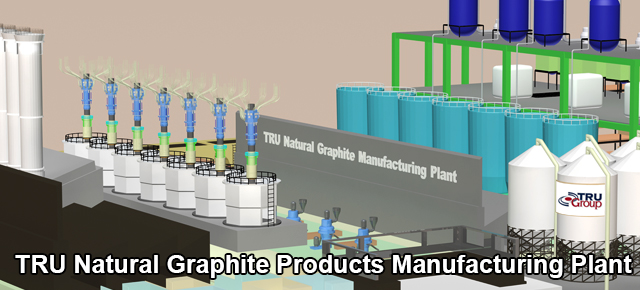
TRU Group Graphite-Graphene Consulting Team has a solid engineering, operations & business capability in graphite from ore resources, through to the manufacturing of upmarket value-added leading-edge graphite-graphene and synthetic graphite end-use products.
 TRU Group Inc - expert at Clean Processing of Natural Graphite: The processing of graphite containing ore to achieve end-user specifications has environmental concerns. Historically lowest cost processing has been the priority but western processors face much stricter environmental restrictions than in China where most graphite originates. Availability of a high quality graphite ore that is amenable to advanced technology
Li-Fibre Carbon Battery Prototype
TRU Group Inc
GRAPHITE CONSULTING SEGMENTS
Natural Graphite Amorphous Graphite
Flake Graphite
Crystalline Graphite
Synthetic Graphite
Spherical Graphite
POWDERED GRAPHITE
Natural Microcrystalline Graphite (Amorphous) • Natural Flake Graphite • Secondary Synthetic Graphite • Primary Synthetic Graphite
GRAPHENE
Natural Microcrystalline Graphite Nanotechnology • Nanotubes • Nanocomposites
OTHER GRAPHITE
• Specialty Graphite Composites • Graphite Felt • Pyrolytic Graphite
BATTERY SYSTEMS & CELLS
BATTERY MATERIALS

Graphite Related


processing is one important factor in reducing environmental barriers. The Group processing to the high grades for li-ion batteries means thermal and/or chemical purification, micronizing, separation of fractions, spherizing and coating. Cost reduction is always a target and realized by process optimization as in other industries. Typically, thermal purification can be cheaper and cleaner but chemical methods of purification are enhanced by recycling and by-product processing. Western technology advances have gone a long way to meet environmental constraints. For example, high-tech spherizing and micronizing can determine the treatment type and level of purification. Indeed, TRU Group in 2020 are engaged in the engineering of the most advanced graphite coating facility - from material through spherical coated graphite - using equipment produced in Japan, Korea, Europe and the United States.
TRU Group Graphite-Graphene Team is the most experienced based qualified available. It includes more than a dozen distinguished graphite-graphene experts who have each worked many years in executive management or as senior engineers / R&D scientists for high tech graphite companies: Graphit Kropfmühl AG Germany, GrafTech USA, Nacional de Grafite Brazil, POCO USA, Superior Graphite USA, TIMCAL, IMERYS GROUP and producers in China. Our team has hands-on experience in the design & engineering of graphite-graphene processes, plants and products - working extensively with many types of natural and synthetic graphite, natural flake graphite, vein, amorphous, ionic clays etc - with detailed knowledge of many different production methods. For example, our team has extensive knowledge of graphite anode & coating for lithium ion batteries. TRU Group believes we have the strongest experienced-based capability in the coating of spherical graphite and indeed this Team in 2020 is engineering a state-of-the-art coating facility for a major US carbon company. TRU Group approach is unique combining its high-tech north American-European graphite expertise with our graphite experts in Brazil & China to provide one of the strongest graphite teams available. We also have a access to a full (non-conventional) capability (in the USA & internationally) for graphite-graphene laboratory testing and piloting operations - from the routine to the most specialized globally. The TRU Group Graphite-Graphene Team tracks the graphie industry including latest 2020 prices. as world-class capability for Feasibility Studies, Investor Due Diligence, Engineering & Technical Analysis in all aspects of graphite-graphene.
Graphite Processing to Coated Spherical Graphite: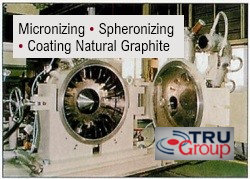 TRU Group 2020 completed an assignment for an American multinational on the complete front-end engineering design of a pilot plant for Li-ion Battery Anode natural (coated SPG) and synthetic graphite materials. For the natural graphite the process included Thermal Processing, Coating technology (Mechanofusion A, Mechanofusion B and CVD by fluid bed), Oxidation Stabilization, Spheronizing and Coating Equipment and Carbonization Kiln. Synthetic graphite anode materials are typically made of graphitized carbon powders with a high degree of graphitization. TRU Group also developed designs for micronizing, spheronizing and coating artificial synthetic graphite.
Matching graphite resource to high-tech niche applications has proved particularly important for the successful profitable graphite operations of today but the matching methods are technically complex - the downstream manufacturing (rather than the ore processing) being by far the major challenge. Indeed TRU Group completed a conceptual feasibility study on what we discovered to be a previously unknown type of graphite: So different that we termed it “STAX Graphite” to highlight the ore’s unique natural Spheroidal, Thin, Aggregate and eXpanded morphology. TRU continues work on the assignment with mineral processing testwork and product development experimentation in the United States. The earlier conceptual engineering of the integrated USA graphite facility included graphite production units for -
- coated spherical graphite for rechargeable li-ion battery anodes
- purified graphite >300 microns for graphite flexibles and converting
- highest purified graphite powders <20 microns friction & specialty products.
 Graphene, nanotubes, nanocarbon and fullerenes - TRU Group is capable in functionalized graphene, graphite oxide, intercalated graphites etc, and the upmarket value-added graphite base, intermediate or final products required of the modern graphite enterprise including -
Graphene Grading Protocol: TRU Group Technical Assessment of Graphene Production and Product Development. Our definition of "Graphene" and its specification parameters for commercial graphene products: TRU Group was engaged by a top-tier US corporation to exame technical issues and advances in graphene production and the prospects for its commercialization of a major North American graphene-containing products developer. In the assignment it became apparent that the industry view of the definition of graphene is controversial. From a pure science view graphene is basically one single layer of sp2 bonded carbon atoms arranged in a honeycomb hexagonal lattice. TRU Group therefore developed its own "grading protocol" for graphene founded on a TRU Group practical definition of graphene which includes up to ten layers because that is the point above which many unique properties of graphene are lost and they resemble those of graphite. The TRU Group definition then includes Few-Layer graphene FLG and Multi-Layer graphene MLG however but excludes nanoplatelets GNP and ultrathin graphite UG and graphene-containing materials. This TRU Group developed Graphene Grading Protocol is based on four parameters:
In addition TRU Group has strong expertise in other specialty carbon technologies such as nanotubes, nanocarbon, and fullerenes. TRU Group has specialty unique expertise in
 carbon-carbon bonding, carbon-ceramic bonding and carbon-metal bonding. For the latest graphite prices and graphite-graphene news also view -

Graphite containing carbon-carbon anode. TRU Group Inc was working in high-tech use of graphite in the early 2000's when it assisted a start-up to search for financing for a revolutionary lithium-ion battery with a graphite containing carbon-carbon anode. This carbon fiber anode material material consists of carbon reinforcement fibers and a carbon matrix. Generally, the carbon-composite fibers provide strength and electrical and thermal characteristics, and the matrix provides structural integrity and fills voids between fibers. The Li-Fiber cell cathode is Lithium Cobalt Oxide and electrolyte Lithium Hexafluorophosphate (LiPF6). Ninety per cent of the material cost for li-ion cells is associated with five cell components – overcharge / over-discharge protection circuit, cathode (LiCoO2 or LiNiCoO2) and anode (MCMB carbon) materials, electrolyte (LiPF6), and separator. The need for over-charge / over-discharge protection circuits or devices contributes significantly to the cost of lithium-ion batteries. The li-fiber battery would not overheat even in high energy capacity applications and requires no significant electronic protection circuit or heat management.
The main sponsor of that assignment are leading suppliers of aluminum graphite, nanotubes (allotropes of carbon with a cylindrical nanostructure), fullerenes (similar in structure to graphite)  spinel and nanocarbons. In addition the firm is specialized in advanced graphite single or multilayer coatings. The carbon nonparasitic obtained from either arcing of graphite under water or thermal annealing of nanodiamonds are commonly called carbon nano onions (CNOs), or spherical graphite, as they are made of concentric fullerene cages. Carbon onion nanomaterials consist of spherical fullerene cores surrounded by onion-like nested spherical graphite layers.
Largest western Graphite Manufactures - Synthetic Graphite & Carbon Electrodes: • GrafTech International, Ltd. • Graphite India, Ltd. • HEG, Ltd. • JSC Energoprom Management • Nippon Carbon Co., Ltd. • SEC Carbon, Ltd. • SGL Carbon Group • Showa Denko Carbon, Inc. Graphite Fibres / Carbon Fibres: • Blue Star • Cytec • Formosa Plastics Group • Hexcel • Mitsubishi Rayon • SGL Carbon, AB • Toho Tenax Group • Toray Carbon • Zoltek - Synthetic Graphite Shapes: GrafTech International Ltd • Graphite India • Ibiden Co., Ltd • Mersen Group • Poco Graphite, Inc. • SEC Carbon, Ltd. • SGL Carbon Group • Toyo Tanso Co., Ltd. Graphite Powder: Asbury Graphite Mills, Inc • China Graphite Ltd • Conoco Phillips • Grafitbergbau Kaisersberg , Gef.m.b H • GrafTech International • X Graphit Kropfmuhl, AG • Hitachi Chemical Co., Ltd • National Carbon (Nacional de Grafite Ltda) • Nippon Carbon Co., Ltd • Nippon Graphite Industries, Ltd. • SEC Carbon Ltd • SGL Carbon Group • Showa Denko Carbon, Inc • Skaland Graphite AS • Superior Graphite Co • Timcal , Ltd. & Stratmin Graphite Div.• Zoltek Corporation •
Graphite - Graphene Juniors: American Graphite Technology, Las Vegas, NV, USA • Anglo Swiss Resources Inc, Vancouver, BC, Canada • Berkwood Resources Ltd., Vancouver, BC, Canada • Big North Graphite Corp, Vancouver, BC, Canada • Canada Carbon Inc, Vancouver, BC • Canada Strategic Metals Inc, PQ, Canada • Caribou King Resources Ltd., Vancouver, BC, • Canada Energizer Resources Inc, Toronto, ON, Canada • Focus Graphite Inc., Ottawa, ON • Graphite One Resources Inc, Vancouver, BC, Canada • Great Lakes Graphite, Toronto, ON, Canada • Mason Graphite, Toronto, ON, Canada • Nevado Resources Corporation, Montreal, QC • Noram Ventures Inc, Madeira Park, BC, Canada • Northern Graphite Corporation, ON• Starex Inc, Libertyville, IL, USA • Standard Graphite Corporation, Vancouver, BC • Starex Inc, Libertyville, USA • Strike Graphite Corp, Vancouver, BC, Canada • Uranex Limited, Melbourne, Australia • Valterra Resource Corporation, Vancouver, BC • Vega Mining Inc, Vancouver, Canada •
Concepts for TRU Group Inc Graphite: graphite consultant, graphite consultants, graphite experts, graphite engineering, graphite plant engineer, high-carbon graphite, graphite technology, graphite battery, graphite electrode, graphite electrode, synthetic graphite, graphene, synthetic graphite, graphite, flake graphite, amorphous graphite, powdered graphite, graphite for lithium batteries, graphite resources, graphite mining, graphite technology, graphite manufacturing, graphite processing, graphite forecast, graphite prices, graphite pricing, graphite supply-demand, graphite conference, graphite papers, graphite epoxy, graphite minerals, graphite oxide, graphite powder, graphite reactor, graphite consulting, micro, carbon nanotechnology,Simon Moores, frontiermaterials, graphene consultant, graphene consultants, graphene experts, graphene engineering, graphene plant engineer, high-carbon graphene, graphene technology, graphene battery, graphene electrode, graphene electrode, nanocarbons Graphite One Alaska Graphite Creek